Beyond Tariffs: How Brussels Summit Redefined the EU-India Partnership
A landmark strategic intelligence report by Water & Shark and EICBI, backed by senior MEPs, Indian MPs, and visionaries Sujit S. Nair, Harsh Girish Patel, and Dr David Bozward, charts a new economic corridor for 2 billion people

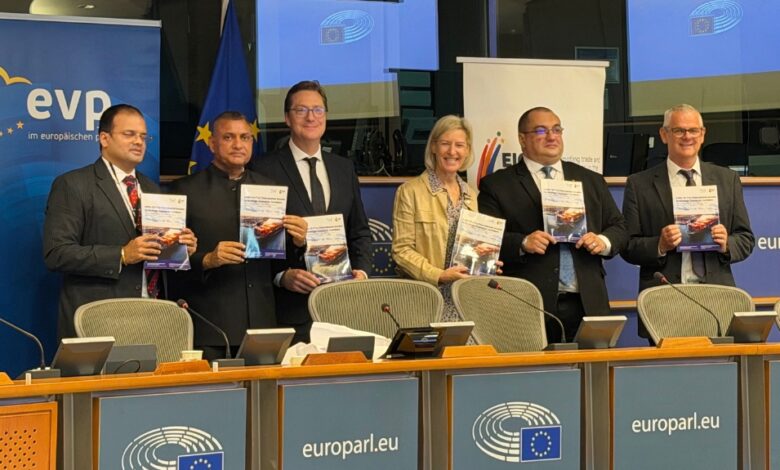
The historic 7th EU–India Leaders Conference (EILC 2026) held at the European Parliament in Brussels marked a decisive shift in the strategic dialogue between the two largest democracies in the world. With a new Free Trade Agreement (FTA) ready to open up a combined market of nearly 2 billion people, the conversation moved decisively beyond tariffs. The theme, “Strengthening Trade & Sustainable Growth Partnerships,” set the stage for a high-level discussion on policy, sustainability, and cross-border architecture, culminating in the launch of a landmark strategic intelligence report by Water & Shark and the Europe India Centre for Business and Industry (EICBI).
Charting a New Economic Corridor at the European Parliament
The day opened at the European Parliament with a powerful address by Ms. Angelika Niebler (MEP, Germany), Chair of the European Parliament’s Delegation for Relations with India. Niebler, who has been a steadfast advocate for deepening ties, used the platform to reaffirm India as a “trustworthy and reliable partner,” underlining the European Parliament’s commitment to the swift ratification of the agreement. Mr. Vladimir Prebilic (MEP, Slovenia), the European Parliament’s Standing Rapporteur on India, observed that after nearly two decades of negotiations, the geopolitical moment was finally aligned, noting that the FTA is “not an endpoint but a foundation” for future cooperation in technology transfer and research. They were joined by Mr. Cristian Terhes (MEP, Romania) of the Committee on Foreign Affairs, who stood with Indian leadership to welcome delegates and stress the urgency of shaping the partnership to meet contemporary economic challenges.
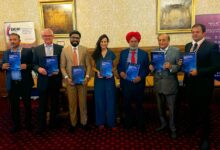
Mr. Sudhakar Singh (Member of Parliament, India), a member of the Parliamentary Committee on Agriculture and a former state agriculture minister, brought a critical and pragmatic voice to the proceedings. Representing India’s agricultural heartland from Bihar’s Buxar constituency, he stressed that while the FTA opens doors, the agreement’s gains must extend to smallholders and respect domestic food security, ensuring that trade liberalization does not come at the cost of rural stability.
Sujit S. Nair’s Leadership in Building the EU-India Bridge
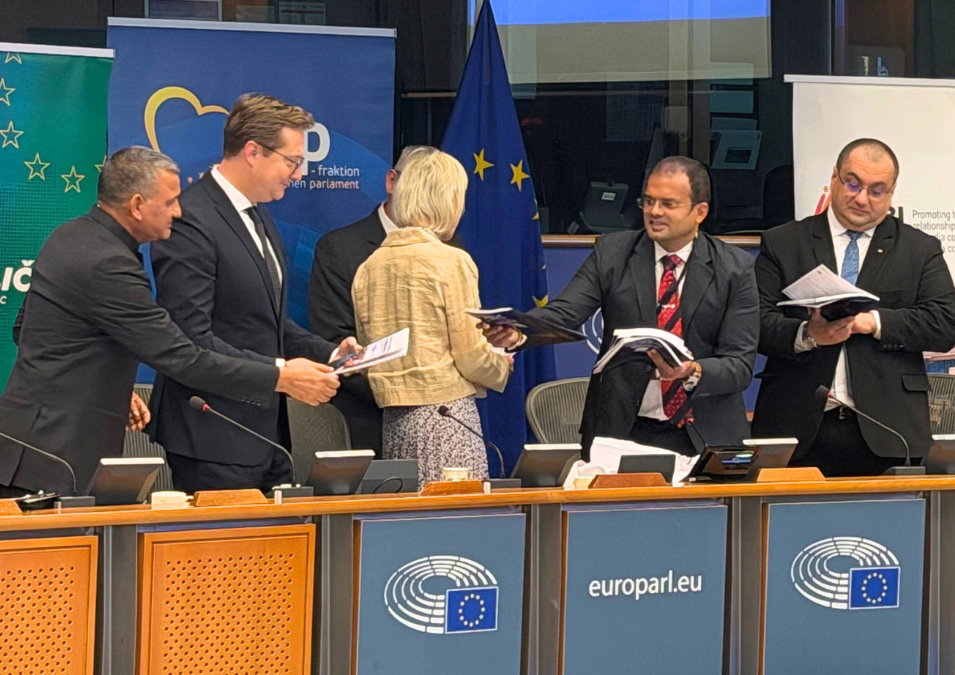
Spearheading this historic dialogue was Mr. Sujit S. Nair, Chairman & Founder of the Europe India Centre for Business and Industry (EICBI) and Senior Partner at Water & Shark. Nair has dedicated nearly a decade to weaving the institutional fabric connecting India to the European Union.
Setting the scene for the day, Nair provided a panoramic overview of the “EU–India corridor,” framing the region not just as a trade route but as a living ecosystem for investment and innovation. In a landmark moment for cross-border business intelligence, Nair oversaw the formal release of the report “India–EU FTA: From Market Access to Strategic Economic Corridors,” developed jointly by EICBI and Water & Shark.
Private Sector Intelligence Meets Public Policy
Representing India’s new generation of thought leadership in global finance, Advocate CA Harsh Girish Patel, the visionary Founder and Global CEO of Water & Shark, was a central figure at the summit. Patel, one of the youngest professionals globally to hold dual qualifications as both a Chartered Accountant and an international lawyer, has steered his firm from a single desk in Mumbai to a global powerhouse operating across twelve countries and four continents. In Brussels, he stepped firmly into the policy arena, reinforcing that the architecture of the deal is as important as the deal itself.

“The conversation must move beyond tariffs and market access, toward architecture and alignment,” Patel stated during the discussions. He added, “For businesses and families operating between India and Europe, success will depend on how early and how intelligently they structure their operations, wealth, and governance. The absence of structure often costs more than the absence of opportunity.” This perspective was later echoed by Dr. David Bozward, Chair of the Water & Shark Global Research Board. Bozward noted that the strategic intelligence report was conceived as a “practical handbook,” one that entrepreneurs, exporters, investors, and policymakers can use to navigate the India-EU corridor from day one of implementation, ensuring that regulatory preparedness determines whether market access is formal or usable.
The Blueprint: “From Market Access to Strategic Economic Corridors”
The newly launched report examines the agreement across fifteen chapters, covering everything from regulatory compliance (REACH, CBAM, GDPR, and the AI Act) to tax architecture and supply chain integration.
Key highlights from the report include:
- Trade Scale: India–EU bilateral goods trade stood at approximately USD 136.54 billion in 2024-25.
- Tariff Access: The EU opens 97% of its tariff lines covering 99.5% of India’s export value, with zero-duty access for textiles, gems, and marine products unlocking an estimated USD 33 billion in potential.
- Regulatory Readiness: The report identifies REACH, the EU Deforestation Regulation (EUDR), and CBAM as critical hurdles, arguing that compliance costs will be the decisive factor in the implementation phase.
- Gateway Office: It introduces the first-ever EU Gateway Office in India, a single hub providing structured migration pathways for Indian professionals in ICT, green technology, and healthcare.
Driving Sustainability and Strategic Autonomy
Beyond the numbers, the summit charted a course for a greener future. A dedicated panel on “Driving Sustainability,” moderated by Ms. Kaveri Sinhji of Impact Think Tank, explored the alignment of ESG frameworks between the two jurisdictions. Speakers highlighted the operationalization of the India-EU Task Force on Green Hydrogen and the €15.2 million joint initiative on EV battery recycling launched under the Trade and Technology Council (TTC). These initiatives underscore that the partnership is not just about trade flows but about creating a resilient, values-based ecosystem for the 21st century.
Government of India’s Strategic Pivot
For the Indian government, the FTA is a cornerstone of its broader economic vision. The agreement aligns with the Viksit Bharat @2047 roadmap, positioning India as a global manufacturing and services hub. Commerce and Industry Minister Piyush Goyal has held multiple consultations with EU counterparts to ensure early implementation. The FTA also complements India’s ongoing negotiations for investment facilitation and defence cooperation pacts with the EU, creating a comprehensive architecture for bilateral engagement.
The report explicitly acknowledges the government’s role in securing favourable terms for Indian exporters, particularly in labour-intensive sectors. It also calls for coordinated action between central and state governments to address compliance capacity gaps, especially for MSMEs across India.
A New Dawn for the EU-India Partnership
As the legal scrubbing of the FTA continues and ratification processes move forward on both sides, the Brussels summit sent a clear signal: the time for reactive policymaking is over. With leaders like Ms. Angelika Niebler, Mr. Vladimir Prebilic, and Mr. Sudhakar Singh laying the political groundwork, and visionaries like Harsh Girish Patel, Sujit S. Nair, and Dr. David Bozward building the strategic infrastructure, the India-EU corridor is poised for unprecedented growth.
The report “India–EU FTA: From Market Access to Strategic Economic Corridors” is available at www.waterandshark.com.